Independent project · Python / PostgreSQL / FastAPI
Coverage
When a source fails, what can you still trust?
Security dashboards can look healthier when a feed stops reporting. I built a platform that does the opposite: it reconciles security feeds, finds coverage gaps and links every finding to the records behind it.
Explore the synthetic replayStep 3 of 5 · Stale
Endpoint assurance
0 healthy / 6 eligible
6 unknown
- Endpoint API
- Last collection failed · evidence stale
- Critical finding · syn-pay-002
- Open
The signature scenario
An outage cannot close an alert.
A critical asset has an open alert when its endpoint feed fails. Follow what the platform reports at each step. Every value below is read from the generated replay.
- Healthy
- Unhealthy
- Unknown
Step 1 Baseline
3 healthy · 3 unhealthy · 0 unknown
Fresh endpoint and alert evidence. A critical alert is open.
Collection succeeded · evidence fresh · critical finding open
Inspect the Baseline stepStep 2 Outage
3 healthy · 3 unhealthy · 0 unknown
Collection fails on page two. The partial result is rejected and the last complete evidence stays current.
Last collection failed · evidence fresh · critical finding open
Inspect the Outage stepStep 3 Stale
0 healthy · 0 unhealthy · 6 unknown
That evidence ages out. Assurance becomes unknown, and the critical alert stays open.
Last collection failed · evidence stale · critical finding open
Inspect the Stale stepStep 4 Recovered
3 healthy · 3 unhealthy · 0 unknown
A complete collection restores assurance. The alert stays open until newer alert evidence arrives.
Collection succeeded · evidence fresh · critical finding open
Inspect the Recovered stepStep 5 Resolved
3 healthy · 3 unhealthy · 0 unknown
Newer resolving alert evidence closes the critical finding.
Collection succeeded · evidence fresh · critical finding resolved
Inspect the Resolved step
Beyond the replay.
The replay tells one story. Run locally, the read-only dashboard covers nine synthetic sources: it leads with open findings, then source freshness, and every finding opens onto the raw records it cites.

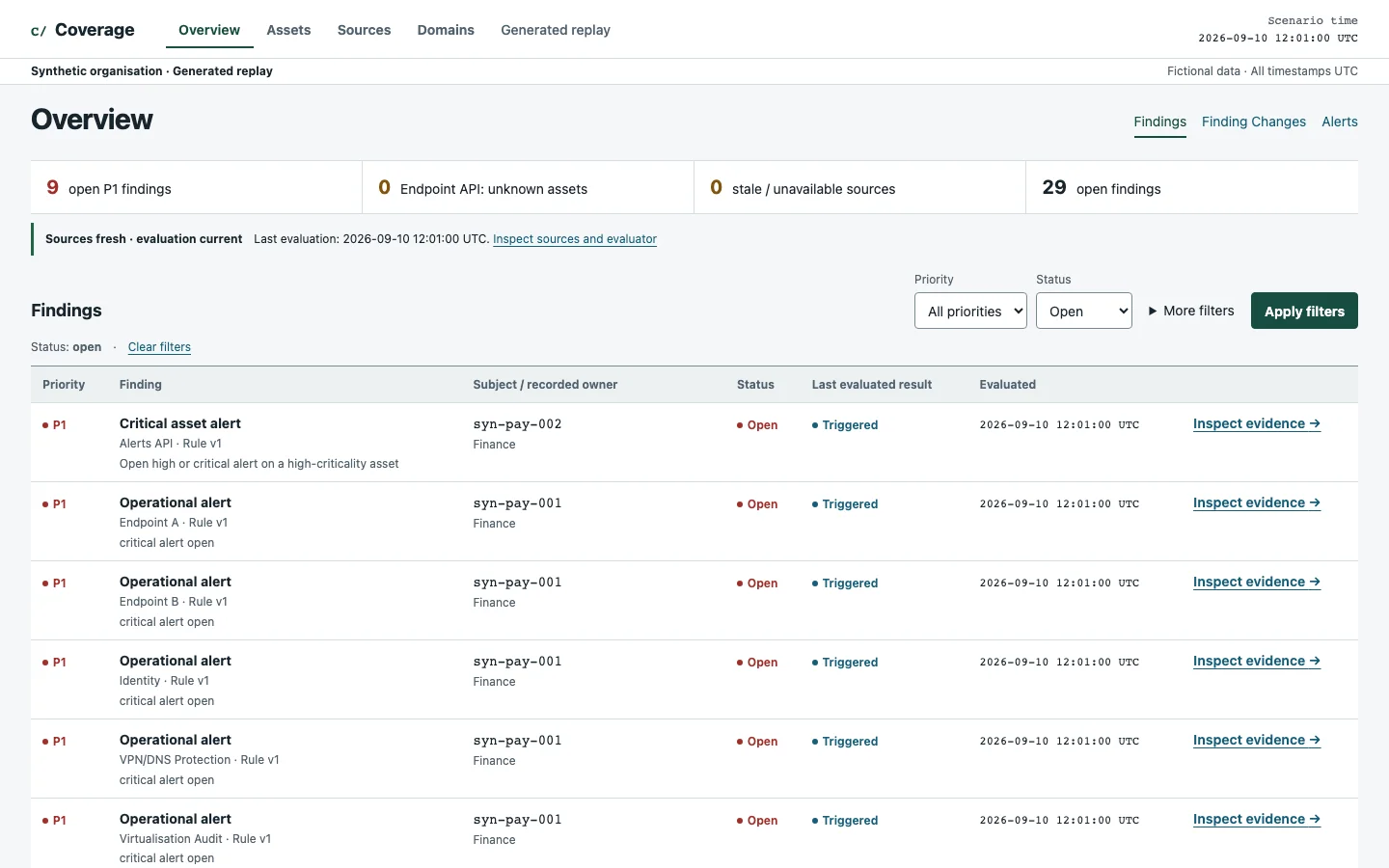

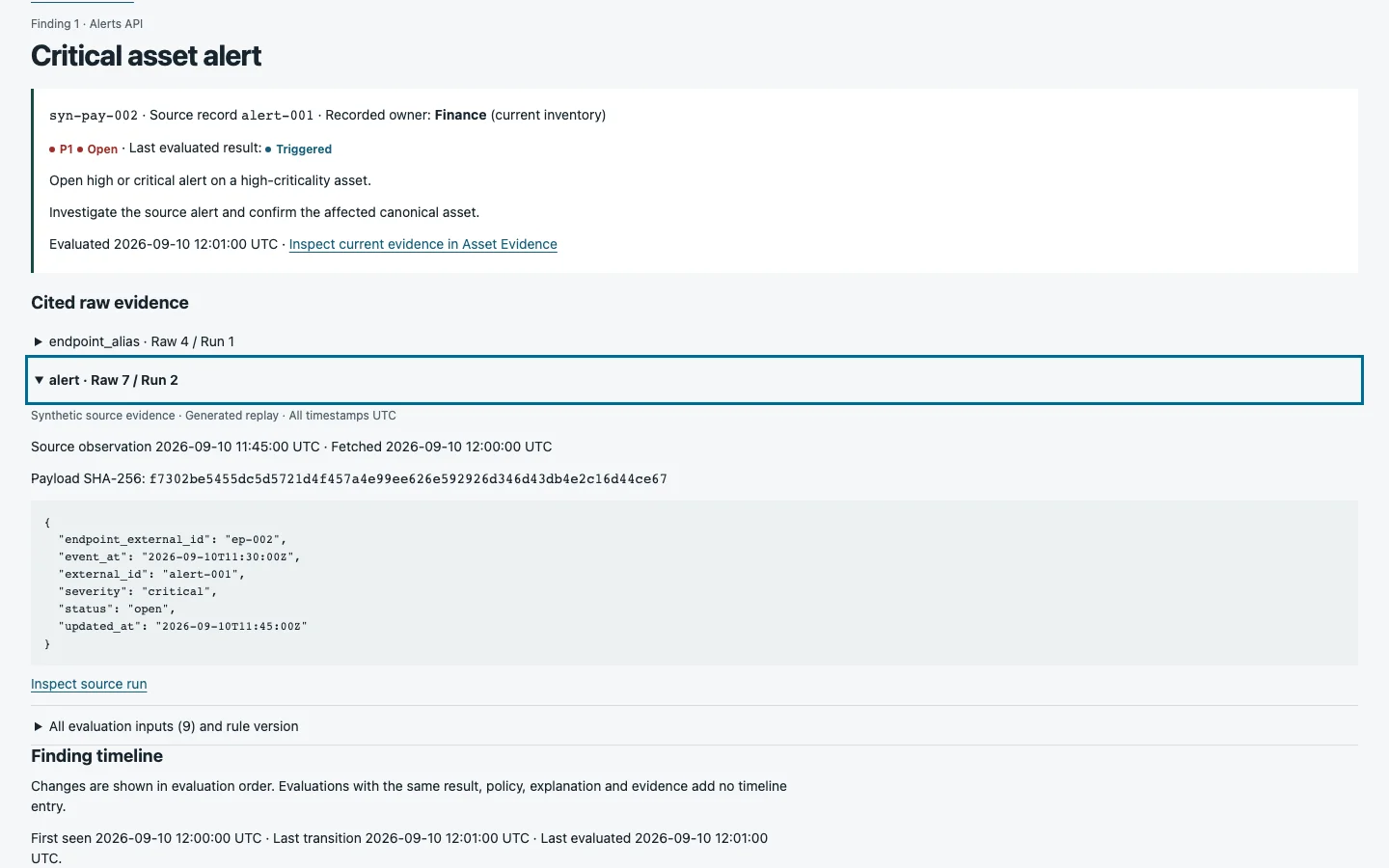

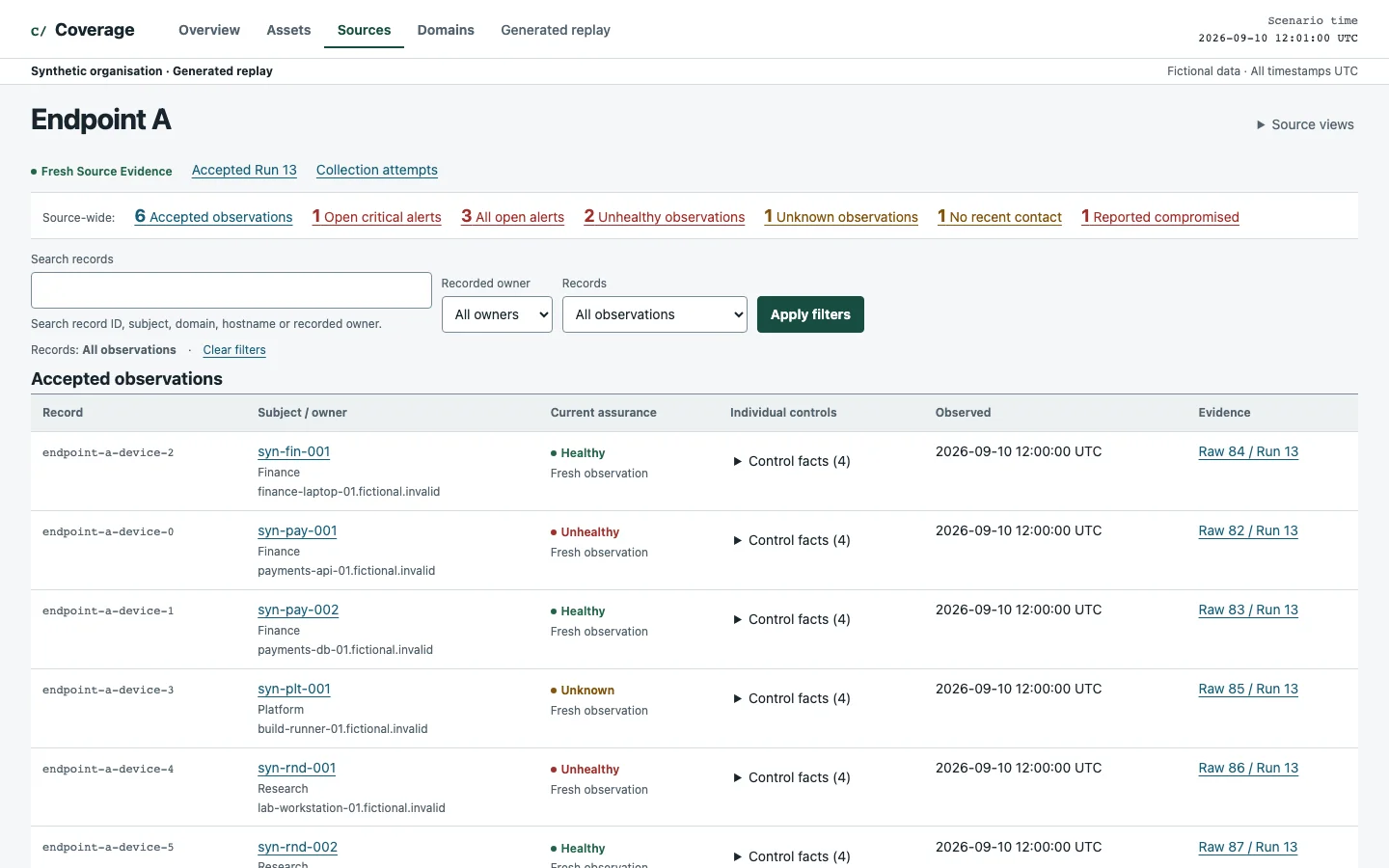
Unedited screenshots from the recorded 8 October 2026 browser check at commit 643fcc4, showing fictional data. The dashboard runs locally and is not hosted.
Follow the evidence.
- A failed collection keeps the last good data. Rejected records stay visible instead of silently replacing it.
- Uncertain identity stays unresolved. When a record could match more than one asset, the candidates are recorded for inspection.
- Old alerts cannot overwrite new ones. Duplicate and late updates cannot reopen a newer resolved alert.
ep-collisionAmbiguous
- Could be
syn-rnd-001syn-rnd-002- Linked asset
- None. Both candidates stay separate.
alert-001critical
- Current state
- resolved, updated 12:20 UTC
- Delivered at 12:30 UTC
open, updated 11:45 UTCkept as evidence, not applied
How I built it.
Each source is collected and checked in full before it is published in a single PostgreSQL transaction, so a half-finished run can never replace good data. Source locks stop overlapping runs from colliding.
The recorded validation includes 420 passing tests against real PostgreSQL and synthetic HTTP, plus a five-run, 5,000-device synthetic benchmark where one index cut the Asset Evidence page query’s median from 1.34 s to 0.15 s.
Read the engineering evidenceWhere the numbers come from.
Four scenarios, 13 frames, 12 fictional devices and five domains, all generated by the real HTTP, PostgreSQL and rules pipeline. Each frame links its raw evidence and records the commit that produced it; input and artifact hashes make changes detectable. This is a local synthetic demonstration, not production monitoring.
Read the original provenance manifest ↗